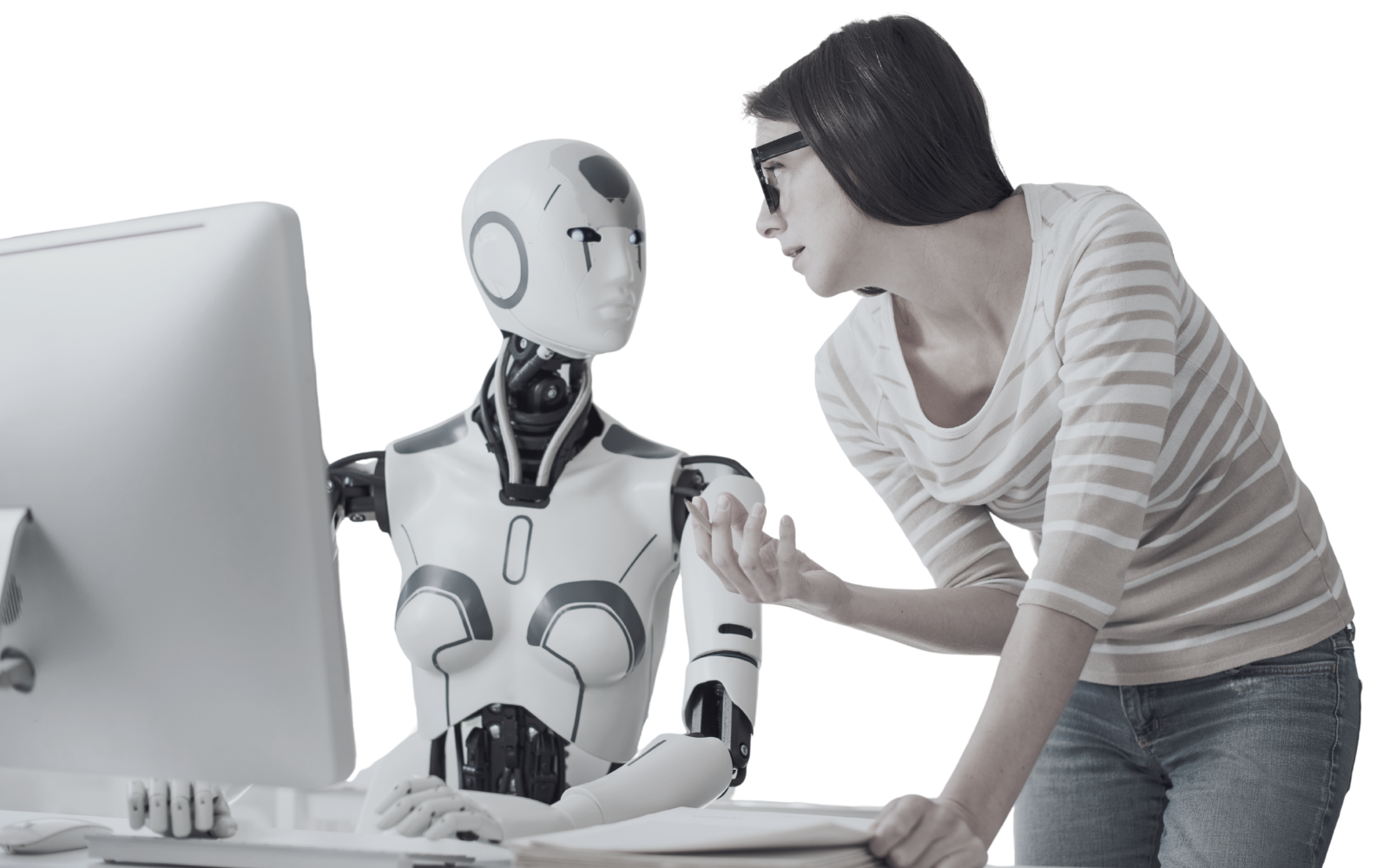
How an AI career planner can plot the next 10 years of your life—and why a dash of self-awareness keeps you in control
You Open an App, and Your Future Lights Up
It’s 7:12 a.m. Your phone pings with a politely confident note: “Your ten-year career path is ready.” One tap and a color-coded timeline spreads out—grad school program in 2027, lateral jump to a sustainability startup in 2029, a six-month sabbatical penciled for 2032, and an executive seat by 2035.
The software behind the forecast feels strangely sure of itself: it has chewed through your résumé, salary data, personality test results, alumni networks, even market forecasts, and produced a life arc slicker than anything you would have mapped on a rainy Sunday.
This isn’t speculative sci-fi. Kickresume’s AI Career Map already offers “career paths that can realistically help you achieve your ideal lifestyle” once you upload a CV. LinkedIn Learning’s new AI coach suggests not only what to learn next but when you should pivot to your “next career step.” Workday’s 2025 AI Trends Outlook urges employers to invest in tools that will “map the next role, rotation, or sabbatical so people can focus on uniquely human judgment.”
An algorithm wants to storyboard your future. You feel flattered—and faintly wary. If machines can outline your life, will you still dream?
Melis Karahan, Change Elements
The Soft Power of Predictive Planning
Behind the friendliness sits a three-layer engine:
Data ingestion – CVs, click-streams, regional salary curves.
Trajectory engine – algorithms rank each job-switch and credential by potential return.
Persuasion layer – glossy calendar visuals plus nudges (“Applications open next Monday; shall I draft your statement?”).
Designers call this micro-inception: a suggestion so personalized it feels like your own idea. It is frictionless planning—until you zoom out and notice that the same feedback loop cutting out unlikely moves (say, a mid-career gap year to paint murals in Oaxaca) might also cut out the very serendipity that makes a life story sing.
Here’s the catch: these planners excel when life unfolds as expected, but struggle with the unpredictable disruptions where human sense-making becomes essential. Cambridge research confirms that while AI outperforms humans in predictive modeling and pattern recognition, humans consistently lead in scenarios requiring intuition, ethical judgment, and strategic foresight.
Philosopher Nick Bostrom points out that small early decisions can have huge long-term effects—like how choosing one college major over another can shape decades of your career.¹ Neuroscientist-turned-AI-theorist Eleni Vasilaki, meanwhile, reframes planning as ongoing dialogue: futures should be co-authored “through conversation, not downloaded as scripts.”²
Human-AI Collaboration: The Value of Going Off-Track
Recent research from Cambridge Judge Business School reveals a fascinating twist in human-AI collaboration. While AI-human teams initially produce more innovative ideas than human-only teams, creativity later stagnated because human-AI partnerships failed to refine and develop initial outputs over time. In 10 rounds of tasks, human-only teams continued to improve creatively while human-AI teams plateaued.
This mirrors what happens with AI career planning. The algorithm excels at generating that impressive initial roadmap, but it struggles with the iterative refinement that makes a life story truly yours. The Cambridge researchers found that AI should be used for accelerating idea generation, but humans must refine and contextualise AI-generated insights. That sleek career map reflects historical norms and patterns—self-awareness helps you spot what’s missing, and what future you’re not seeing.
This isn’t an argument against letting AI assist. It’s a reminder that life’s richness doesn’t come from efficiency—it comes from friction, detours, and the kind of goals we discover only after deviating from the plan.
Where the Algorithm Ends and Self-awareness Starts
Self-awareness—not super-creativity or ironclad control—is the modest, repeatable human counter-move. Neuroscientist Anil Seth reminds us that the self isn’t a stable target AI can aim at—it’s a process, stitched moment by moment from sensation, memory, and interpretation. So when my planner proposes “who I’ll be” in 2035, it’s not wrong—but it’s frozen. That frozen self may feel efficient, but my real self evolves in dialogue with surprise.
Three micro-habits help me keep hold of the pen:
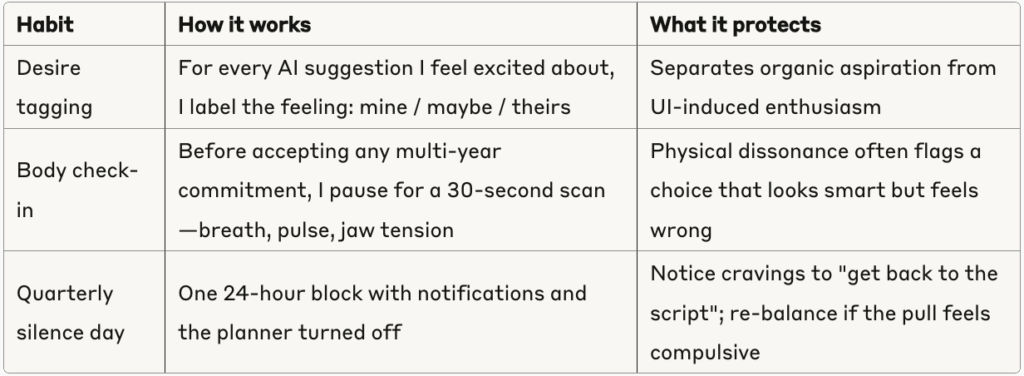
These moves won’t impress a self-help guru. Good—they’re meant to be light, boring, doable. I don’t need to out-create the machine; I just need to stay sufficiently awake that its probabilistic confidence doesn’t harden into destiny.
AI Career Planning: Two Stories
The complacent success. Daniel, a 29-year-old data analyst, accepted his planner’s roadmap completely: certification this year, fintech move next, MBA in 2029. By 2031 he’d hit every milestone—and felt curiously hollow. “I realized,” he tells me, “that nothing in the last five years would surprise my eighteen-year-old self. I’d optimized, but not evolved.”
The aware tinkerer. Mina, a nurse in São Paulo, liked 90% of her AI arc—but the model pushed an MBA. She felt her chest tighten. Instead she carved out Fridays to shadow a mobile health clinic, a wildcard the algorithm hadn’t glimpsed in her data. Two years on, she’s launching a micro-clinic network. “The planner gave me structure,” she says, “but the mismatch showed me the itch I really needed to scratch.”
Neither story is apocalyptic. One shows what happens when we ignore the faint signal of self-awareness; the other, what shifts when we heed it. Cambridge research suggests why this matters: AI models optimized for historical patterns often fail when market conditions change unexpectedly. Unlike human executives who build in strategic flexibility, AI tends to focus on things that worked in the past rather than new techniques that might work better in the future.
Co-designing with the machine
So how do we harness these planners without handing them the keys?
Breadth from AI, depth from you. Let the tool propose broad possibilities; have meaningful conversations with trusted people about which paths truly resonate.
Blank weeks. Schedule unallocated time every quarter—future space the algorithm can’t pre-book.
Wishlist the model can’t see. Keep a private notebook (or encrypted file) with aspirations the data doesn’t cover—dream jobs, sabbaticals, moonshot hobbies.
Diversity audit. Before locking plans, ask two mentors with contrasting values to poke holes. Algorithms compress variance; friends re-inflate it.
These boundaries aren’t anti-tech. They assume the planner is a brilliant, data-rich ally—as long as you, the flesh-and-blood protagonist, stay a tad unpredictable. As AI ethicist Stuart Russell puts it, machines that try to perfectly optimize human lives without staying humble about what we actually want are “misaligned by design.” The most trustworthy AIs are those that assume they don’t fully know us yet—and keep asking.
The trust paradox
Here’s where human psychology gets interesting. Cambridge researchers found that across six countries and ten different decision scenarios, majorities generally favor human decision-makers over algorithmic ones—even when the algorithm demonstrably performs better. This “algorithm aversion” is particularly strong among older adults and persists even when people are given information about how the algorithms work.
If you feel resistance when your ai career planner hands you a future, that’s not irrational—it’s the beginning of self-authorship. That flicker of hesitation is your agency speaking up. Trust your hesitation; it’s a gift, not a bug.
Melis Karahan, Change Elements
But there’s a flip side. When people do trust AI models completely—what Cambridge calls “taking digital twins for granted”—the model can start to shape decisions on its own, sometimes more than the people using it. The sweet spot lies between these extremes: enough trust to benefit from AI’s analytical power, enough skepticism to maintain human agency. Your planner is part of a team where humans bring ambiguity, nuance, and felt sense—and sometimes override the shiny models.
Vasilaki imagines community “scenario jams” where neighbors and AIs brainstorm plural futures for, say, a coastal town facing sea-level rise. She describes this as a “dialogue of plural intelligences“—neither AI nor human leads, but both contribute iteratively. The key isn’t whose idea it is, but whose values it reflects, and who gets to ask, “What if we tried something different?”
The closing note—small refusals, spacious dreams
You swipe back to your brightly painted timeline. But you delete the clean-edged retirement date and instead you block a month in 2030 and label it “event horizon—ask again later.”
A good future plan should fit like a tailored jacket: supportive, yet roomy enough to breathe.
The point isn’t to outwit the algorithm; it’s to remember that the dreamer is still inside the data. Dreams, it turns out, grow best in the blank spaces of your plans.
MeLIS KARAHAN, CHANGE ELEMENTS
References:
- Bostrom, N. on long-termism and trajectory shaping
- Vasilaki, E. on collective foresight and dialogic futures
- Cambridge Judge Business School: Human brain vs AI decision-making